Sunday, October 23, 2016

TOW #6 - Don't Dress Your Age

In the New York Times article, “Don’t Dress Down,” author Julia Baird preaches to women, trying to persuade us to dress as we wish. Julia Baird is actually an Australian journalist for The New York Times, broadcaster, and author so she is able to write to women in Australia and The United States. Baird’s purpose for sharing this with her audience is because she was “old shamed.” She retells an anecdote from when she was looking for a vintage dress and her former husband said in her ear: “You know, there comes a day when wearing old-lady dresses is no longer ironic.” Not only was that a rude thing to say to her, but it made her feel old. She was only 36 at the time so she wasn’t even middle aged. She uses a metaphor to express how she felt that she was dressing, “And apparently not even a lamb dressed as mutton, but fast approaching mutton dressing as jerky.” So what exactly does it mean to “dress your age?” How does someone dress at 16, or 21, or 42? Women are criticized for wearing things that make them look "too young" or "too old," so where is the happy medium? The media and popular culture are one of many reasons as to why women feel so discouraged when they step out of their homes. Once you turn 40, you should use "plenty" of conditioner and avoid getting your haircut into a bob, according to a fashion writer in The Telegraph. A Daily Mail survey showed that women a quarter of 50 year old women and up are afraid it wear high heels. Titles like "Are You a Middle-Aged Fashionista Who Just Doesn't Know When to Quit?" are very crestfallen, because women deserve to feel good and look good. Julia Baird did reach her purpose, in my opinion, because she advised her readers that whenever someone tries to "old shame" them, just brush it off because women merit the right to appreciate and love themselves.

http://www.nytimes.com/2016/10/23/opinion/sunday/dont-dress-your-age.html?_r=0

Sunday, October 16, 2016

TOW #5- "The Allegory Of the Long Spoons"


Image result for the allegory of the long spoonsWhen I was on snapchat I saw a video that really opened my eyes. It showed six people sitting around a platform that held a bowl of soup. But what made this more interesting was that the platform that the soup was on was surrounded by an abyss that would "lead to your doom." The audience then sees the six people in black and white, the only color coming from the soup. They are all sitting on the edge and are trying to get some of the soup, but because their spoons are so long, they cannot reach their mouths. After a man accidentally spills soup on another, a fight breaks out and the people end up with five spoons instead of six. After a few moments of silence, we see another spoon into view, trying to feed the man whose spoon broke. Once the man gets a small taste of the soup, the images around them are no longer black in white. The space around them is bursting with vivid color. After some research, I found that this story was an ancient Jewish parable. The parable is supposed to show the difference between Heaven and Hell. In Heaven the people there eat at long tables and feed each other with long spoons and are always full. Whereas the people in Hell only try to feed themselves, which leads the audience to believe that people in Hell are starving. This parable is most often told at church sermons. In my opinion, this piece conveys dramatic irony. I believe that because the people in the audience know how the problem could be solved, but the people in the actual piece do not. Although the original artist is not knows, I think his purpose was to get more people to follow Judaism because if they weren't active in their faith, they would end up going to Hell. The author, in my opinion, achieved his purpose because Judaism is one of the oldest Abrahamic religions and is still practiced all over the world. Without this, then maybe the Jewish church wouldn't exist.

Sunday, October 9, 2016

TOW #4 - IRB Review The Glass Castle


I finished reading The Glass Castle by Jeannette Walls and it was a very frustrating book to read. Don’t get me wrong, Jeannette Walls is a very talented author, I just felt that the people in her book were lazy. Jeannette never really had a chance to be a kid. Her father was a drunk and her mother was “free spirited.” Her mother never really paid any much attention to Jeannette or her siblings because she wanted them to learn on their own. In some ways that could be beneficial, but in other ways it can be very harmful. Since Jeannette had to take care of herself, she set herself on fire at three years old while making hot dogs. Something that I found very sad was that Jeannette shared that she liked staying in the hospital because she never received that kind of attention at home. Her father on the other hand was well liked by Jeannette. On several occasions, Jeannette called herself “his biggest supporter,” because one day when he found enough gold, he would make them a dream house. But instead of actually looking for gold, he spent his money on alcohol. This book is obviously made up of many powerful anecdotes. I remember that during one of the many Wall's family moves, Jeannette's father grabbed the family cat and threw him out of the window. After, her mother scolded Jeannette and replied, "Don't be so sentimental"(Walls 18). This really shocked me because this shows the tone that her parents had with Jeannette and it definitely was not a loving tone. Another important device that was used in this book is imagery. Not only does Jeannette convey imagery to create a setting, but she uses it to express her emotions and feelings. On the first page of the book, she tells her audience about her mother "dumpster diving." She describes her mother's appearance and makes it easier for her audience to visualize what her life was life. Although this book frustrated me at the beginning, it made me see how strong Jeannette was and the things that she had to overcome.


Sunday, September 25, 2016

TOW #3 - What is Cultural Appropriation and Why is it Wrong?

Vanessa Hudgens appropriating the Hindu culture.

While watching snapchat stories yesterday, I saw something that made me extremely upset. A Caucasian girl wearing cornrows. Why does that make me upset? It makes me upset because it is one of the many ways that people can appropriate my African heritage, which is better known as cultural appropriation. Now what is cultural appropriation? According to Race Relations Expert, Nadra Kareem Nittle, “it typically involves members of a dominant group exploiting the culture of less privileged groups - often with little understanding of the latter’s history, experience, and traditions.” In this article, Nadra Kareem Nittle’s purpose is to educate and explain to American teens why cultural appropriation is wrong.
Cultural appropriation is used often by artist in the music industry. To name a few, figures like Gwen Stefani has been accused of using cultural appropriation due to her obsession with the Harajuku culture from Japan. Another artist is Miley Cyrus. At the 2013 MTV Video Music Awards, Miley stunned the audience and people at home by "twerking." Twerking is a dance style that traces back to the African American community. In her music video "We Can't Stop," she is seen twerking again but this time uses black women as her background. "On stage as well as in her video, she used the tedious trope of having black women as her backing singers, there only to be fondled by her and to admire her wiggling derriere," said Hadley Freeman, writer of The Guardian. I agree with Freeman because not only is Miley Cyrus making an imitation of black music, but she is using black women as sex objects. Cultural appropriation can range from music to wearing traditional or ceremonial attire as a fashion statement.
So why did I get so upset when I saw the Caucasian girl wearing cornrows in her hair? I was upset because I begged my mom not to give me cornrows because the other little girls told me that they were ugly; but now they are suddenly fashionable? I am upset because black features are praised, but only when they are not on black women.


http://racerelations.about.com/od/diversitymatters/fl/What-Is-Cultural-Appropriation-and-Why-Is-It-Wrong.htm


Sunday, September 18, 2016

TOW #2 - Tim Kaine, American Dad, Makes His Pitch to Millennials

Author for The New Yorker, Ben Wallace, shared that last Thursday, Senator Tim Kaine traveled to New Jersey to speak to Millennials and try to convince us to vote for Hillary Clinton. During his speech, he showed Donald Trump’s book, Crippled America, and his and Hillary Clinton’s book, Stronger Together. “We’re both smiling,” he pointed out. Trump, he said, had contrived to look both condescending and sour in his, “sitting in a penthouse, looking like he’s sucking on six lemons.” As recent polls have stated, it shows Millennials voting for Green Party candidate Jill Stein or Libertarian Party candidate Gary Johnson. In my opinion, I feel that this election is a joke and will lead up to the worst four years in America’s history. No one wants Hillary because she is a “liar” and “untrustworthy,” but no one wants Donald Trump because… well, he’s Donald Trump. Gary Johnson and Jill Stein are great candidates but us Millennials know most of our information from social media. Donald Trump has 11.6 million followers on twitter and Hillary Clinton has 8.8 million followers. Gary Johnson and Jill Stein do not even reach 1 million followers, which leads me to think that even if millennials voted for Jill Stein or Gary Johnson, there wouldn’t be enough votes for them to win because they are not as well known as the Democratic and Republican candidate. I think the author of this article is trying to explain why Tim Kaine and Hillary Clinton need the Millennial vote. Tim Kaine knows that there are more Millennials voting than Baby Boomers, or those in Generation X.

I frankly do not know how I feel about Tim Kaine. Before Hillary Clinton chose a running mate, she was talking all about diversity. The twittersphere was suspecting that she would pick someone other than a straight white male. But, her running mate ended up being exactly that. Tim Kaine seems to have had a successful run as Virginia’s senator, but to us millennials, he just doesn't seem to be enough. I just think that we were a bit disappointed with her selection because we were hoping for more diversity, perhaps a Vice President that was a person of color. I do believe that the author reached his purpose because, although I can’t vote, it made me realize that if millennials do not vote for Hillary Clinton, then we will end up with Donald Trump as president, which makes me cringe even thinking about his presidency.
http://www.newyorker.com/news/benjamin-wallace-wells/tim-kaine-americas-dad-makes-his-pitch-to-millennials


Sunday, September 11, 2016

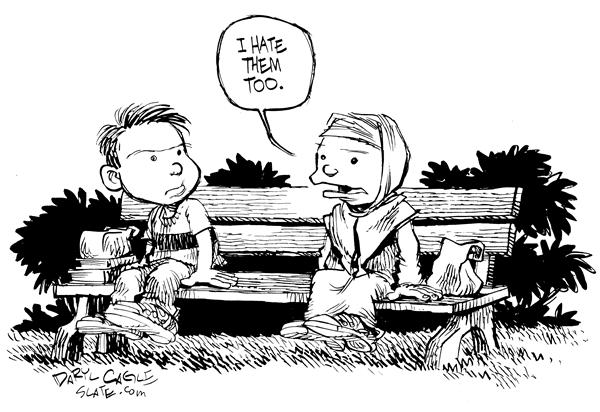
TOW #1 "I Hate Them Too."


Daryl Cagle - MSNBC.com - I hate them too - English - kids, hate, mad, talk, Muslim, American, belief, same, bench, Islam, terror, terrorism, Middle East, burqa


It’s that time of the year again, when the whole nation is mourning. Americans and people all around the world remember the tragedy that occurred on September 11th, 2001. The well known terror group, Al-Qaeda, committed 3 terrorist attacks. One on the Pentagon in Washington D.C., the second crashed in Pennsylvania, and the third at the World Trade Center in New York City, New York. Just 5 days after 9/11 MSNBC’s Daryl Cagle released this cartoon to the American public. In the cartoon above, we see two children. They both carry a sack lunch in an identical bag and wear the same shoes, but one child is different than the other. All though they don’t look the same, they are the same on the inside. One of which is dressed as the “typical american boy.” The other child is seen in traditional Islamic apparel. Because the attacks were committed by an islamic extremist group, it made many Americans have a prejudice against muslims. This political cartoon in a prime example. The little boy is giving the girl a disgusted stare while she says simply, “I hate them too.” Americans always say “Never Forget” when speaking about 9/11. I believe that Americans haven’t forgotten but they certainly haven’t forgiven. I’m not saying that what Al-Qaeda did wasn’t completely awful, but I am saying that not all muslims are bad. Islam is a religion that revolves around peace. “In Arabic, the word ‘Islam’ means submission or surrender – however, it was derived from the root word ‘salam’. From this root word, you can also derive the words peace and safety.” (muslimvoice.org) I think the author's purpose for drawing this political cartoon was to show that after September 11th 2001, all Americans were grieving. All races, religions, and ethnicities were mourning. From my point of view I believe that Daryl Cagle achieved his purpose. He did make me and others realize that all Americans were affected by this brutal terror attack, including Muslim Americans. Some Americans do not realize the prejudices and dilemmas that Muslims and Muslim Americans face everyday just because Al-Qaeda and other terrorist groups put the islamic faith in a bad light; but if more people around the world would see this cartoons and cartoons similar to this one, then maybe islamophobia would not be such a problem in the world.

Wednesday, September 7, 2016

IRB Intro Post #1

In 2005 Jeannette Walls published The Glass Castle. This book shows how her and her siblings were neglected by their parents and were forced to look out for each other. I chose this book because Jeannette Walls tells the story of her struggle and her eventual prosperity. The Glass Castle helps readers find that if you work hard, you will always get the result that you want in the end.